
On June 5th, 2024, IWP hosted a one-day colloquium titled “Liaison & Legacy: Edward Geary Lansdale,” focusing on the late U.S. military intelligence officer, advisor, and expert on irregular warfare who practiced his craft in the Philippines and Vietnam. This paper was created as a part of the colloquium.
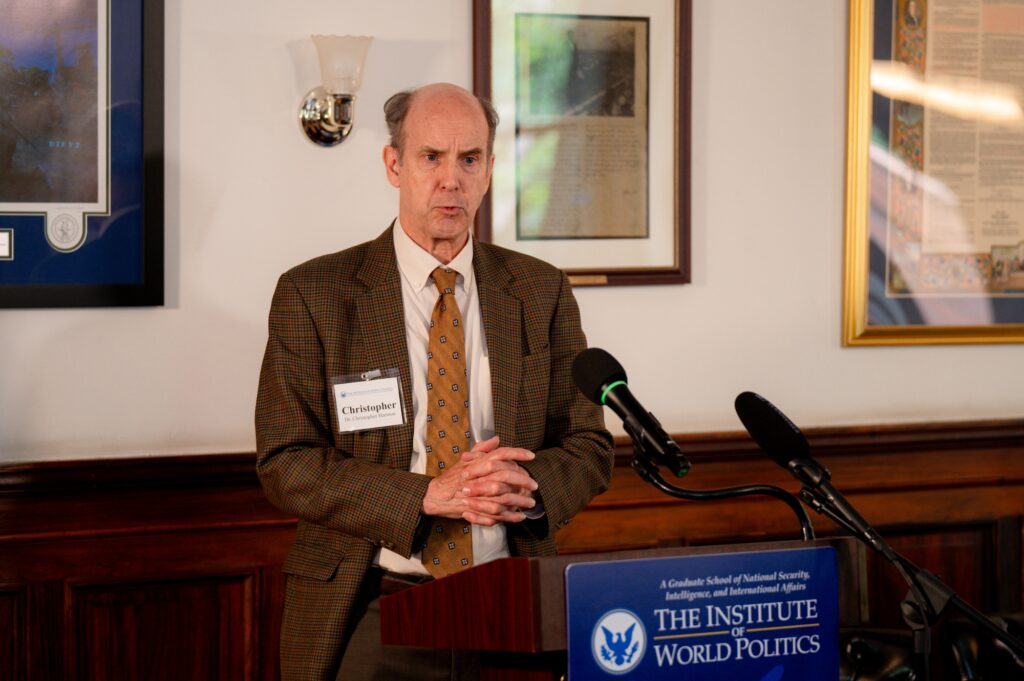 Christopher C. Harmon speaking at the Lansdale Colloquium
By Christopher C. Harmon | 27 May 24
Idealism and public spirit smolder in the extant speech texts of Edward Geary Lansdale. “The True American” was the title of remarks offered to a group interested in how U.S. liaisons might best present themselves to Filipino counterparts in 1960.[1] Six months later, “The Free Citizen in Uniform” was the label on another set of ideas; the phrase announced the essence of the speaker—as well as his hopes for the audience—as he addressed the U.S. Army Civil Affairs School at Fort Gordon, Georgia.[2] A rich writing and speaking life was maintained by this military officer and intelligence expert. The urgency in his efforts to motivate did not retire when he left the Air Force in 1963: Within two years, Lansdale had written a syllabus sketch for a new American school, “a private Freedom Academy to be operated for the public good.”[3]
What characterized Lansdale, what he consistently offered to foreigners and Americans alike, was a high-minded view of man’s prospects in a democratic society. He hated tyranny and loved freedom as its opposite. He believed in God as Creator, and he admired a famous Founder’s words about the shared receipt of “certain unalienable rights.” He venerated our Constitution and was ready to respect any other, if it was good, without caring that it was not drafted by the American Founders. In the difficult national conversation (which continues today as between isolationists and neo-conservatives and others) Lansdale stood with the 18th century’s Thomas Paine as an “exporter” of liberty and democracy in U.S. foreign policy.[4] He despised Communism for its crippling effects and for all its differences with humankind’s best ideas, and he fought Communism in a life of action as well as a flow of advice.
A Lansdale speech and the Lansdale writing style expressed his personality; they were popular, pleasant, direct. “Any Man” could be listening—or reading—and grasp his intent, his theme, and the point of his occasional stories from the field. The texts were elevated but also dipped down to earthy levels in many places, pulling the listener along with him through a jungle path, or seating him for tea at the crude table of a friendly peasant’s hut. His work brought him to speak to many assemblies and lecture in many schools, but for American audiences, there were always direct words of caution: “My task will be to stimulate your thinking on this subject—for you will have to translate your thoughts into deeds when you graduate,” he said to civil affairs trainees.[5]
Intellectual Convictions
The student Edward Lansdale did not graduate from the University of California at Los Angeles. And his best-known civilian job was in advertising in San Francisco. But such facts belie the serious reading which informed the fellow. He was fascinated with the American Revolution and studied what he called its “ideology.” In his talks, there were references to such founders as Benjamin Franklin, George Washington, Adams cousins John and Samuel, and, of course, Thomas Jefferson, whose words had a special grip upon the 20th century center of our story.
Revealing his instinct for action, Lansdale likewise probed deeply into the operational history of that revolution. What made it work? What did people do to win? His answer included:
The practical philosophy and techniques of the American Revolution, including the history of the formulation and agreement upon political precepts, the psychological operations of Sam Adams and Tom Paine, clandestine organizations such as the Committees of Correspondence and the Committees of Safety and their operations, control and operations of the Sons of Liberty, guerrilla operations, clandestine foreign support (France and Spain), defection operations such as the Hessian surrenderee program, and the successes and failures of British pacification operations (attraction programs, counterinsurgency doctrine, etc).[6]
Admiration for radical democratic ideas of the late 18th century’s Thomas Paine was no mere labeling effort for Lansdale. Ordered into South Vietnam when the new country born under the Geneva Accords was floundering, Lansdale immediately contacted Washington for a copy of the 1776 pamphlet Common Sense. He told his lieutenant Rufus Phillips how he loved the Paine quotation: “Where liberty dwells not, there is my country.” As a specific example of deploying Paine’s Common Sense, Lansdale dealt with one talented advocate of Vietnamese nationalism, Bui Anh Tuan, a passionate “revolutionary journalist.” The two shared the wide aspiration of seeing idealism fuse with the Vietnamese spirit and grow democratic feeling and institutions in the new South Vietnam. Writing inspiring “op eds” in newspapers was thus a concrete task for Bui Anh Tuan in which Lansdale was the liaison. This little partnership, involving two influencers and ideas men, expresses the larger enterprise. “We should think of ourselves as friends and brothers of the Vietnamese, Lansdale would say. “Our job [is] to help them win back their revolution from the communists.”[7]
No one who has studied the mid-20th c. wars that involved Lansdale can miss the significance of the utility of these studies for him to grasp how other national liberation efforts might be realized and comprehended. The honest and humane ones he wanted to encourage. He saw democratic militant populism alive (and successfully kicking Communism’s shins), recommending study of “the Burmese Defense Forces, the 1950-1953 Philippines campaign against the Huks, and the Vietnamese pacification campaign of 1955 for examples of how to use civic action effectively…”[8] Here was an instinct that drew John F. Kennedy to Lansdale’s side, even at a time when there was little respect for this one intelligence officer among his counterparts in the Pentagon or D.C. bureaucracies. A few, the clear-eyed, could perceive how “anti-Communism now has a revolutionary context,” as one patriot amidst Vietnamese struggles put it, later quoted in Foreign Affairs magazine by Lansdale.[9] Here, too, was the instinct that would animate Ronald Reagan’s doctrine of materially aiding foreign freedom fighters against their new communist regimes backed by Soviet power.[10] Lansdale and Reagan, each in his time, materially and ideologically empowered indigenous anti-communist fighters.
A Serious Student of Maoism
Detesting the final ends of the Communists, Lansdale nonetheless respected the skill set that he observed advancing movements loyal to Vladimir Lenin, Mao Tse-tung, and Ho Chi Minh. Mao was cited often by Lansdale—more often than he spoke of Franklin Roosevelt, Harry Truman, or Dwight Eisenhower—because he was quietly indignant about how little his audiences knew of Mao’s revolutionary warfare theory and practice. The American officer well-respected Mao’s instructions to his revolutionaries to begin with a studious appraisal of local conditions.
Economics mattered. So did dialectical materialist interpretations of economics which party spokesmen learned to talk about and use to skewer local landlords and governing officials.[11] Communist grievances and ideas were just as useful in persuading some among the open-minded citizens who were trapped in the war among the peoples and insurgents. Party members of the Hukbalahap revolutionaries of 1946 onward were often intellectuals, Lansdale reported; as educated Maoists they understood the facts on the ground and then used their observations of local circumstances in shaping political and rhetorical efforts, slowly winning over enough among a population to make factual inroads and begin laying down administrative infrastructure. This is the rural action method Mao learned and then taught: study first, then influence and act. Clandestine political organization and a controlled amount of terrorism were parts of the formula. And always there was the information war, the public competition for the economic and political forms of the future.
Communist internationalism—a kind of dark obverse of Paine’s democratic coin—was another central theme of the era’s revolutions—and therefore also of Lansdale’s speeches and advice. Not taken seriously by some analysts—then or now—this doctrine proclaimed the necessary interconnectedness of all global efforts by workers and their militant party representatives. For the party with its agit-prop teams and guerrillas, the challenge was always to adapt to time and place, as Lansdale explained to U.S. Army personnel in a June 1961 talk:
Communism is, of course, an international effort. In each country, its expression, its activities, are tailored to the local situation. If those directing it are clever, the Communist program becomes so well adapted to local conditions, to local issues, local grievances, and local people that it appears to be a home-grown product. You will find some seeming differences among the programs in different countries, but you will find many, many more points of similarity.[12]
The era’s Communists accepted, but segregated, “nationalism” so animating many peoples and labored to blend each “national” struggle with the international cause. Where possible, the militants suppressed differences between Moscow and its once-dutiful ally Beijing; those were not bared as a gross gap until at least 1960. In many ways, the communists’ progress in Laos, or Vietnam, or the Philippines all tended in the same directions, a changing correlation of forces in the world, which successive premiers Nikita Khrushchev and Leonid Brezhnev would assert with pride. All this necessarily made our contest global. Lansdale made the point to the Air Force Academy in Colorado in a speech that became part of the teaching packet for the U.S. Mission’s Rural Affairs section in South Vietnam:[13]
Today’s battlefield is the result of a strategic flanking movement. For some time now, the Communist leaders have made it plain that they expect to conquer the world…Our great and alert [conventional] strength has served as a military deterrent, which has forced the Communists to take the long way around in trying to reach their goal. The “long way” is conquest by subversion in all of its aspects, supported by guerrilla forces when needed.[14]
As a lecturer, Lansdale often described the ideological demands the Huk leaders placed upon their subordinates. This was natural enough; Communist intellectuals trained in Maoist thought. But Lansdale’s experience showed him how little American auditors were ready to appreciate the deeply political character of the people’s war. We are skeptical; Communists are not, he seemed to say. Americans even in the Cold War might not agree when told their enemies were “Stalinist,” so Lansdale enjoyed telling them that the Huks called their training centers “Stalin Universities.” His emphasis on Huk ideology showed in such fora as a July 1963 colloquium within the RAND Corporation (a government-funded think tank). Revolution is political, and Luis Taruc as “The Supremo” sent his military people to school, pressing into their minds: “the history of the Communist Party in the Philippines,… courses in dialectical materialism, and ….autocritique or self-criticism to superimpose Communist psychological discipline on military discipline..”[15] This accords perfectly with Maoist methods, including criticism of un-informed and raw militarism.
Trained political officers then went out with the military units, on deployment, as in the Soviet Red Army or Mao’s military. This involved dogma in both civil-military relations and further party ideology. Party officers were “largely…intellectuals from universities, city boys, while the military were mainly the farm boys. The intellectuals went to great lengths to maintain control.” One of their methods was enforced self-criticism—each subordinate had to make voluntary offerings about his or her defects as a good organizational member. Maoist self-criticism was a lecture point that recurred in talks by Lansdale, in part because he was sickened by the cipher-like status expected of lower ranks, diminished subjects, not “free citizens in uniform.” Ho Chi Minh’s method in this vein—derived from Mao—was called “autocritique” by French in Indochina.
For a Sound U.S. Counterinsurgency Doctrine
Lansdale always said one must oppose Communist doctrine with a better idea, not merely deprecate Communism.[16] So in his challenges to audiences and journal readerships, he might ask Americans to stop, think, and see that the phrase “people’s war” was real, that the fight was real and winnable by Americans and partnered peoples abroad, so long as they, the indigenous, had the lead themselves. We were a revolutionary success story. We could aid others’ nationalism. In a deeply thoughtful paper composed in the late 1960s for the Institute for Defense Analyses, this veteran of long struggles in the Philippines and Vietnam advocated outright for a “Lincolnian Yardstick.” We should not assess our efforts by bomb tonnages dropped nor by numbers of American soldiers on the ground; his greatest success had been against the Huks, without U.S. bomber aircraft and with no more than a half-dozen U.S. advisors out with Filipino troops. Instead, Lansdale offered as metrics of success the rubrics “Of the People, by the People, and for the People.”
Outside Communists in Vietnam, especially the Chinese advisors and soldiers, were not “of the people,” yet they worked to integrate, using subtlety and attentiveness to local feelings. Ethnic Chinese could be somewhat unwelcome in Vietnam, and even in the Philippines, yet propaganda campaigns smoothed their way and “sold the concept that the Chinese helping the local Communists were “socialist comrades.”[17] American advisors could do the same, said Lansdale, continuing the thought; the ideals of equality and liberty which they advanced would be preferred by locals to Communism. Certainly, they were no more foreign to the Vietnamese than Communist doctrines! As the 1950s began, Lansdale carefully and openly cultivated Ramon Magsaysay, a World War II Filipino veteran-turned-congressman who was talented, charismatic, and lucky enough to rise to military and political heights—literally to the presidency. Lansdale recognized the strength of Magsaysay’s roots in the people and said: “He…loved and trusted them, and understood the full danger to the people’s welfare of the Communist Huk movement.”[18]
Nationalist leadership “by the people” must be facilitated by education systems, Lansdale felt. France had done the opposite in Indochina, excluding too many locals who should have been trained, welcomed, and integrated into governance. France could not see the Indochinese running their own affairs. Smarter, Moscow ran the “University of Toilers of the Far East,” from which Ho Chi Minh graduated in 1924. Such Soviet and Chinese schools imported and educated and trained partisans from Southeast Asia by the thousands, over time. The effort favored the advancement of their graduates, indigenous to Indochina and now ideologized. The Americans tried in Vietnam, with very limited success. The U.S. had performed much better in the Philippines after 1900, using Army men to teach in English in new public schools in that first decade and importing thousands of other Americans to teach as well. Such U.S. actions helped indirectly elevate good and learned people into authority in the next decades. “After 1950, the people felt sure that their own kind were at the head of the government campaign against the Huks.” It became a national war, “by the people against the Huks,” noted Lansdale.[19]
And “For the People”? The Philippines had a fine constitution, and Magsaysay and others defended it well, Lansdale wrote, offering a simple and sad contrast with Vietnam. They “have had three Constitutions…since 1956. The first two became scraps of paper in the violent overturns …,” especially the murder of Nationalist leader and President Ngo Dinh Diem. The result has been political and constitutional chaos, reflects the author; the serious in Viet Nam must ask themselves if their countrymen care. “They won’t win freedom and peace for their country unless they do.” A basic short-hand statement of American policy in the country had been “to secure an independent, non-communist government in South Vietnam.” Some added the adjective “democratic.” In Lansdale, we may notice adding the noun “society” to “government.” Lansdale always thought about “people” and himself as a liaison. In one conclusion of a task force in which he had an influential role, their report to the White House in Spring 1961 said that “prevention of Communist domination” would require “a viable and increasingly democratic society in South Vietnam…”[20]
With democratic and nationalist impulses registered, Lansdale’s more practical advice then flowed. He lectured before any number of audiences and huddled with smaller numbers for long discussions, about the substance and sequence of what is required to carry people’s war ideals into successful revolutionary or governing activity. Genuine positive feeling. Population management of kinds that separate out the guerrilla. Fiscal support to government programs of action and aid. Humane and effective leadership of field forces. Troop discipline—akin to what the Communists preach in Mao’s 8th Route Army doctrine, copied by the Vietnamese in their own fight. In the Philippines, Magsaysay and Lansdale created a school to train the new intelligence officer, and another to train the new officer in “Civic Action,” a phrase Lansdale says he invented and fostered.[21] These specialists were then integrated with existing forces, increasingly well-led due to their responsiveness to the respected leadership of the former anti-Japanese guerrilla chief Magsaysay. All this meant better civil-military relations in the field, making life more safe, giving democracy promise, and furthering free elections. The latter were aided by massive civilian volunteering efforts under the acronym NAMFREL, or National Movement for Free Elections, Philippines, which today is still at work to promote valid balloting in the Philippines. In all such things, the skillful spy from America stayed in the background where possible, emphasizing indigenous efforts, indigenous talents, indigenous leaders.
It is upon these firm political grounds that Magsaysay and Lansdale built up the now-familiar methods of irregular warfare. Components were spoken of by Lansdale’s team at the Fort Bragg seminar of June 1961 and included: good leadership (including at small unit levels); emphasis on combat intelligence and its winnowing from the populace due to good relations with them; patrols and relentless patrolling, as against massive conventional offensives; and psychological warfare and propaganda.[22]
Lansdale Always Gave Locals the Last Word…..
It is regrettable how current American scholarship on Lansdale has lost so much of his idealism and fidelity to freedom and related political principles and respect for the ideas guiding democratic revolutions. Typical of one dark corner of thought and publishing in the last few decades has been the stink of cynicism in pages of the mistitled volume In Our Image by Stanley Karnow. We are led to feel that the U.S. did not really believe in Filipino freedoms and democracy and was not really mentoring the Philippines towards those ideals in the decades after the U.S. vanquished the Spanish empire. Yet such freedoms, promised by U.S. policy makers, were realized with success by a new republic by 1954/1955. The alternative, the Huks, were beaten—by the people and for the people, without any U.S. combat forces. Yet we are lectured at by Karnow about damnable “jingoism” and advised that, really, America’s role was almost reducible to the overlording and exploitation of the “little brown brother.”[23]
Notice how such critics, so free with their pens, never write about the soul and intellect and Lincolnian spirit of Filipino successes. Among these is Ramon Magsaysay, who by authoritative accounts before Karnow’s of 1989 was beloved by Filipinos.[24] Magsaysay was also the closest of friends with Ed Lansdale; many have said they were like brothers. This brave anti-Japanese guerrilla, turned bus company manager, turned Congressman, become Secretary of Defense, elected President, understood better what his countrymen had experienced and earned, and what they could aspire to. Stanley Karnow’s fat book found no room for one page giving us (and virtually no American book ever gives us) the text of the magnificent “Credo” published by Magsaysay upon taking the highest office. It was a fulsome expression of him—and of his political mentor E. G. Lansdale.
I first saw and copied this free verse at the statue for Magsaysay downtown in Manila. It is of a sort that Thomas Paine would love. Since taking down the words, I’ve read them with a certain reverence to audiences in Asia and America, realizing how entirely new the lines are to most auditors—even some Filipinos.[25] We quote them in full here. It is a Filipino statesman at his moral apex—not Stanley Karnow’s “little brown brother.” The “Credo” is one short version of the long mid-20th century story of Magsaysay and Lansdale and the bilateral relations of two peoples and two countries. The newly elected president of the newly independent republic gave his thrilled countrymen these Lincolnian promises, and then worked to fulfill them until his untimely death in 1957:
I believe that government starts at the bottom and moves upward, for government exists basically for the welfare of the masses of the nation.
I believe that he who has less in life should have more in law.
I believe that the little man is fundamentally entitled to a little more food in his stomach, a little more clothing on his back and a little more roof over his head.
I believe that this nation is endowed with a vibrant and stout heart and possesses untapped capabilities and incredible resiliency.
I believe that a high and unwavering sense of morality should pervade all spheres of governmental activity.
I believe that the pulse of government should be strong and steady and the men at the helm imbued with missionary zeal.
I believe in the majesty of constitutional and legal processes, in the inviolability of human rights.
I believe that the free world is collectively strong and that there is neither need nor reason to compromise the dignity of man.
I believe that communism is iniquity, as is the violence it does to the principles of Christianity.
I believe that the president should set the example of a big heart, an honest mind, sound instincts, the virtue of healthy impatience, and an abiding love for the common man.
—Ramon Magsaysay, 1954
[1] Our colleague Kevin D. Smith acquired copies of a number of Lansdale papers some years after the principal’s death. Studying these was my inspiration for the present chapter.
“The True American” is a six-page typescript in seven sections, dated June 3, 1960.
[2] “The Free Citizen in Uniform,” a seven-page typescript in seven sections for a talk at a U.S. Army Civil Affairs School by Brig. Gen. Edward G. Lansdale, USAF, at Fort Gordon, Georgia, November 1, 1960.
[3] “Freedom Academy: Preliminary Working Study,” by Edward G. Lansdale, Maj. Genl, USAF, Ret.; undated, 24 pp. This group of documents anticipated the opening of an advanced school he hoped to see in Yorktown, VA.
[4] References here to the Creator, on the one hand, and on the other to Briton-turned-American Tom Paine, are from the beginning and end of the memoir: Edward Geary Lansdale, In the Midst of Wars: An American’s Mission to Southeast Asia (New York: Harper & Row, 1972), ix, 375-376. One of his Foreign Affairs articles prods those who find it odd or immoral to speak of “exporting American political principles…” “Viet Nam: Do We Understand the Revolution?” by Major-General Edward G. Lansdale, vol. 43 #1 (October 1964), 79.
[5] Address at Fort Gordon, 1960, op. cit.
[6] “Freedom Academy,” cover page, op cit.
[7] Ben Franklin had said “Where liberty dwells, there is my country;” Tom Paine made the rejoinder quoted. This juxtaposition of quotations is also on the first page of the Preface to Lansdale’s 1972 memoires, above.
The story from Vietnam is in Rufus Phillips, Why Vietnam Matters (Annapolis, MD: Naval Institute Press, 2008), 23-24. Phillips was deputy for Rural Affairs for the U.S. mission in South Vietnam under the direction of Lansdale. Much later he authored two books, both generous to his mentor’s ideas. Phillips died in 2022.
[8] “The Free Citizen in Uniform,” p. 5.
[9] Dan Van Sung addressing other Vietnamese nationalist leaders in July 1963; quoted in “Viet Nam: Do We Understand the Revolution?” by Lansdale, op. cit., 81.
[10] “The Reagan Doctrine” was actually named by columnist Charles Krauthamer and the president, then in his second term, seemed to appreciate the label. Certainly, his foreign policy in both terms was a direct expression of his desire to help foreigners fight for their freedom and against communist regimes. See affairs in Afghanistan, Nicaragua, Angola, etc. Christopher C. Harmon, “The United States, the Reagan Doctrine, and the Nicaraguan ‘Contras,’” ch. 3 in Warfare in Peacetime: Proxies and State Powers (Quantico, VA: Marine Corps University Press, 2023), 75-108.
[11] Many Lansdale articles and speeches mention the facility with which trained party activists used Marxist speech and slogans. When the special killer team “Force X” was organized by the Filippino armed services to ape Huk methods and infiltrate, all selected for this special work had to learn Marxist patter, not just aspects of dress, taking of meals, and equipment.
[12] “Counter-Guerrilla Operations in the Philippines, 1946-1953,” transcript of a seminar at Fort Bragg, N.C., 15 June 1961, with favored teammates from Philippines operations Maj. M. Justiniano, Col. I. Lapus, Col. N. Valeriano, and Maj. C. Bohannan, 9.
Lansdale told his Ft. Bragg audience that “The Communist politburo had carefully analyzed the people’s grievances, adopted the righting of those wrongs as their rallying slogans, and then exploited the situation with great skill,” 4.
[13] The re-use of Lansdale’s Colorado speech in Vietnam is noted by Phillips, op. cit., 130.
[14] “The Insurgent Battlefield,” a talk at the Air Force Academy by Brig. Gen. E. G. Lansdale, USAF, on May 25, 1962, a nine-page typescript in eight sections. I have added one bracketed word. Among his closing points, the speaker added: “Although the enemy tries to give his guerrillas a local appearance, often they have international strengthening.”
[15] Lansdale added that Huk guerrilla chief Luis Taruc owned “a set of law books sent up to him in the mountains, where he learned enough to become a lawyer while he was running military operations.” Symposium on the Role of Airpower in Counterinsurgency and Unconventional Warfare: The Philippine Huk Campaign, eds. A. H. Peterson, G. C. Reinhardt and E. E. Conger (Santa Monica, CA: RAND Corporation, July 1963); Lansdale remarks are at 20, 22, 27, 28, 31, etc.
One orthodox American Communist on the Huks’ education and propaganda staff was William Pomeroy, who was later captured and authored the revealing memoir The Forest: A Personal Record of the Huk Guerrilla Struggle in the Philippines (Quezon City: University of the Philippines Press, 1963; repr. 2010). He never speaks of Stalinism and notes that hand-lettered diplomas might say “The Sierra Madre Training School: The People’s University.”
[16] Examples are in “The Free Citizen in Uniform,” p. 4, and the afore-cited Foreign Affairs article, 76.
[17] “A Comparison: Viet Nam & The Philippines,” by Edward G. Lansdale, M/Gen., USAF, Retired, written for the Institute for Defense Analyses, n.d., 31 pp. Pages 20-23 apply his “Lincolnian Yardstick” and include remarks about “Sinophobia” in S.E. Asia.
[18] Lansdale, Ft. Bragg seminar, 4.
[19] “A Comparison,” 20-2.
[20] This 1961 (Lansdale) team report is quoted by Guenter Lewy, America in Vietnam (New York: Oxford University Press, 1978), 20. Emphasis added. The present author came to Lewy’s fine book by the kindness of Dr. Ken Masugi.
[21] In the Midst of Wars, 70.
[22] Ft. Bragg seminar, 6.
[23] The irony in the patronizing words “little brown brother” is in how little Lansdale could feel condescension. He literally invented the phrase “civic action” as he and Magsaysay transformed the attitude of the Filipinos in the army towards their own countrymen, and at one point Lansdale’s explanation for that phrase was “brotherly behavior.” That is a small ”d” democrat speaking, not a colonialist. Condescension by some American officials was a problem, but Lansdale’s methods of liaison were the corrective to it. Therefore, it is Karnow who is condescending; his view of both Lansdale and Magsaysay is what is condescending.
[24] The general and positive sentiment comes through strongly in Lansdale’s memoirs, the Currey biography, the Abueva biography, and the writing of Rufus Phillips, as examples. Anyone reading of the popular passion manifest at the inauguration of the president in 1953 must come to the same conclusion. Mr. Karnow is sure he knows better…. but why?
[25] The full “Credo” of Magsaysay does appear—without emphasis—within the immense biography of the leader done by academic Jose V. Abueva, Ramon Magsaysay: ‘Servant Leader’ with a Vision of Hope, 2nd edn. (Manila: CLCD, 2012), 13